



Interview
Pooling Technical Expertise to Turn Standard-Dimensional Constraints into Design
A "Tree Stump" Pavilion Built with Temporary Site Materials
How did the exhibition concept "New Sustainable Life with MAKE BEYOND" and the future-oriented message "Embrace Nature, Embrace Happiness" discussed in Episode 01 translate into the final design and structure?



Profile

OBAYASHI CORPORATION
Assistant Manager
Architectural Design Solutions Department
Marco Capitanio
Born in Italy. After working in architectural design overseas, he came to Japan and joined the company in 2021. At OBAYASHI MORI SORA MIRAI, he is responsible for architectural design, focusing on the spatial composition of exterior structures and entrance areas. In his day-to-day work, he uses computational design to automatically generate designs and simulations, working on tasks such as design optimization and 3D-printed architecture projects.

OBAYASHI CORPORATION
Manager
Structural Engineering Department
Shotaro Murata
Joined the company in 2010. At OBAYASHI MORI SORA MIRAI, he is responsible for overall structural planning. During the internal design competition for the pavilion, he collaborated with Hiroki Minoura from the Architectural Design Department, who appeared in Episode 01. He also felt a connection to the project because he lives in Yokohama City, the host city for GREEN×EXPO 2027. He is primarily engaged in structural design for office buildings, arenas, and similar structures.

OBAYASHI CORPORATION
Expert
Mechanical & Electrical Engineering Department
Yuki Hatanaka
Joined the company in 2010. He is responsible for overall electrical equipment planning for OBAYASHI MORI SORA MIRAI. He designs power supplies for key operational systems—show lighting and air-conditioning equipment—and is also involved in exterior lighting design that contributes to the pavilion’s nighttime illumination. He also frequently handles building services design for logistics warehouses.
OBAYASHI CORPORATION
Mechanical & Electrical Engineering Department
Ken Yasuda
Joined the company in 2024. He joined this project in his second year at the company. This is the first project for which OBAYASHI MORI SORA MIRAI has handled design work. He is involved in creating comfortable environments through planning HVAC systems and plumbing/sanitary facilities, as well as selecting equipment.

Index
-
For the Six-Month Exhibition Period, in Line with Sustainability
Construction-Site "Temporary Materials" Adopted as Building Materials for the Pavilion
-
Achieving a Sense of Accomplishment by Fulfilling Challenging Orders
Pay Attention to the Technological Capabilities of the Obayashi Group
-
Still Room for Improvement
Creating for the Next Stage
For the Six-Month Exhibition Period, in Line with Sustainability
Construction-Site "Temporary Materials" Adopted as Building Materials for the Pavilion
 Marco
Marco
Taking Minoura's idea, we created a landscape design based on the motif of a "tree stump" that gives off a half-natural, half-artificial atmosphere. The tree stump represents Obayashi Corporation as an "Explorer" that will pioneer the future.
While decision-making took time due to the involvement of diverse stakeholders and employees, the design exploration process offered many valuable lessons. Additionally, as an internal project, we were able to try out new software and workflows, and being able to validate their effectiveness was a major takeaway.

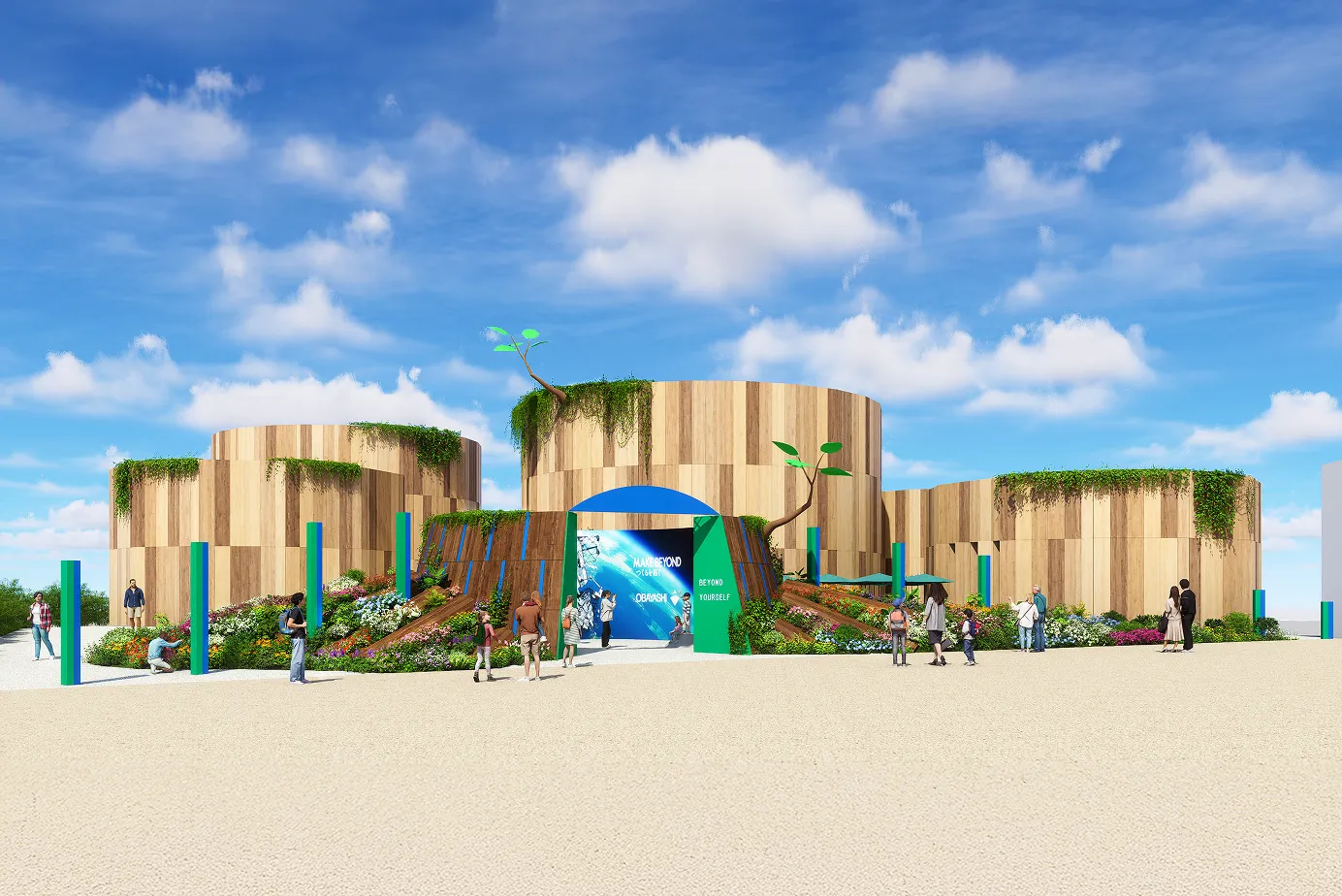
Exterior rendering of OBAYASHI MORI SORA MIRAI, composed of multiple cylindrical buildings linked in a series, inspired by the motif of a "tree stump."
 Murata
Marco
Murata
Murata
Marco
Murata
Specifically, we arranged leased scaffolding materials (Albatross (*1)) around the outer perimeter of the buildings as exterior support members, and inside, we built a structural frame using shoring materials (yamadome) (*2) together with Albatross beam frames, creating a building compliant with the Building Standards Act. Additionally, we adopted Lamina panels (wood-based panels) for the exterior cladding, considering their contribution to carbon neutrality. Furthermore, by employing a structural framing system (*3) using compression rings (*4) and tension rods (*5), we created a distinctive structural design. Each component was assigned to the most suitable location to maximize its strengths, thereby constructing the exhibition space.
- *1Albatross
A temporary work platform erected at high elevations on construction sites to enable workers to move and work safely. Widely used as next-generation scaffolding that balances enhanced safety with improved work efficiency. - *2Shoring materials (yamadome)
Temporary steel supports used to reinforce retaining walls, preventing soil collapse and ground subsidence during deep excavation. - *3 Structural framing system
A structure that supports a building's load by combining columns, beams, and other elements to form a framework. - *4Compression Ring
A ring-shaped reinforcement member installed at the central opening or apex of shell-structured roofs, such as those in domed baseball stadiums. - *5Tension Rod
A structural member that resists forces by "pulling" to support the building.
Achieving a Sense of Accomplishment by Fulfilling Challenging Orders
Pay Attention to the Technological Capabilities of the Obayashi Group
 Hatanaka
 Marco
Hatanaka
Marco
Hatanaka
 Yasuda
First is the outdoor installation of "Comfy TOUCH" (*6). This incorporates cold/hot water panels into benches, creating "ultra-localized heating and cooling" that utilizes heat conduction and radiant heat. Visitors can directly touch the panels to feel a cooling sensation, enabling localized, highly energy-efficient, and effective heat countermeasures.
The second is the "in-DUCT" air outlet type (*6) for installation in exhibition rooms. This technology integrates the air intake mechanism with the air outlet, drawing in surrounding air to increase the airflow volume. This allows the air conditioner itself to reduce its airflow volume, lowering fan power consumption. It achieves reductions in power consumption and CO2 emissions, while also suppressing condensation.
Finally, the "Saratto Mist" (*6) is installed outdoors. By spraying a fine mist that doesn't feel wet upon contact, it generates evaporative cooling, lowering the surrounding air temperature by 2-3 °C to create a comfortable environment.
This technology is incorporated into "The brænch" (*6), a structure made with a metal 3D printer at the Obayashi Corporation Technology Research Institute―a project in which Marco is also involved. I believe this structure truly symbolizes the fusion of technologies within the Obayashi Group.
- *6Links available only in Japanese
 Marco
Marco
Still Room for Improvement
Creating for the Next Stage
 Hatanaka
Marco
Hatanaka
Hatanaka
Marco
Hatanaka
 Murata
Looking ahead, there are plans to deploy these Lamina panels as wood-based temporary fencing panels at Obayashi’s construction sites in the future. The evaluation from this project could serve as an important test case for that initiative. In that sense, we also hope you will pay close attention to the exterior design.
Yasuda
Furthermore, regarding the Obayashi Group's technologies I mentioned earlier, their appeal truly comes through when you "experience them firsthand". We would be delighted if experiencing them on-site sparked even a little interest.
Murata

The departments and job titles shown are current as of April 2026.

Top